
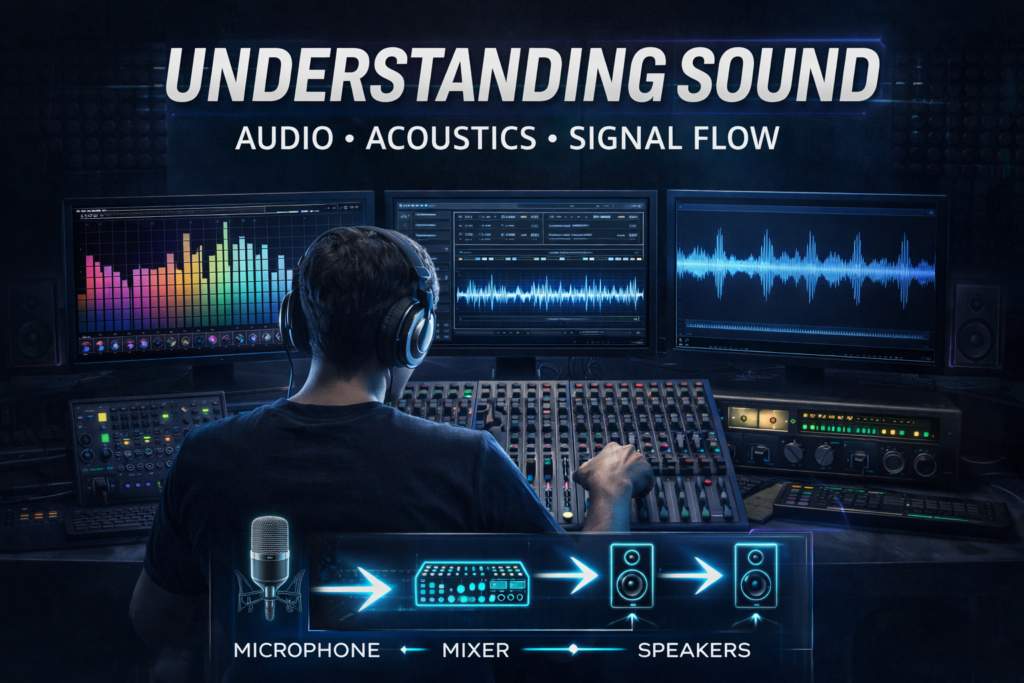
In audio production, we often focus on plugins, microphones, converters, or monitoring systems.
But before processing, before mixing, before mastering — there is something more fundamental:
Sound itself.
If you truly understand how sound behaves physically and acoustically, your decisions in the studio become more intentional, more accurate, and more controlled.
This article covers the essential foundations of sound in physics, acoustics, and audio signal flow — in a clear and practical way.
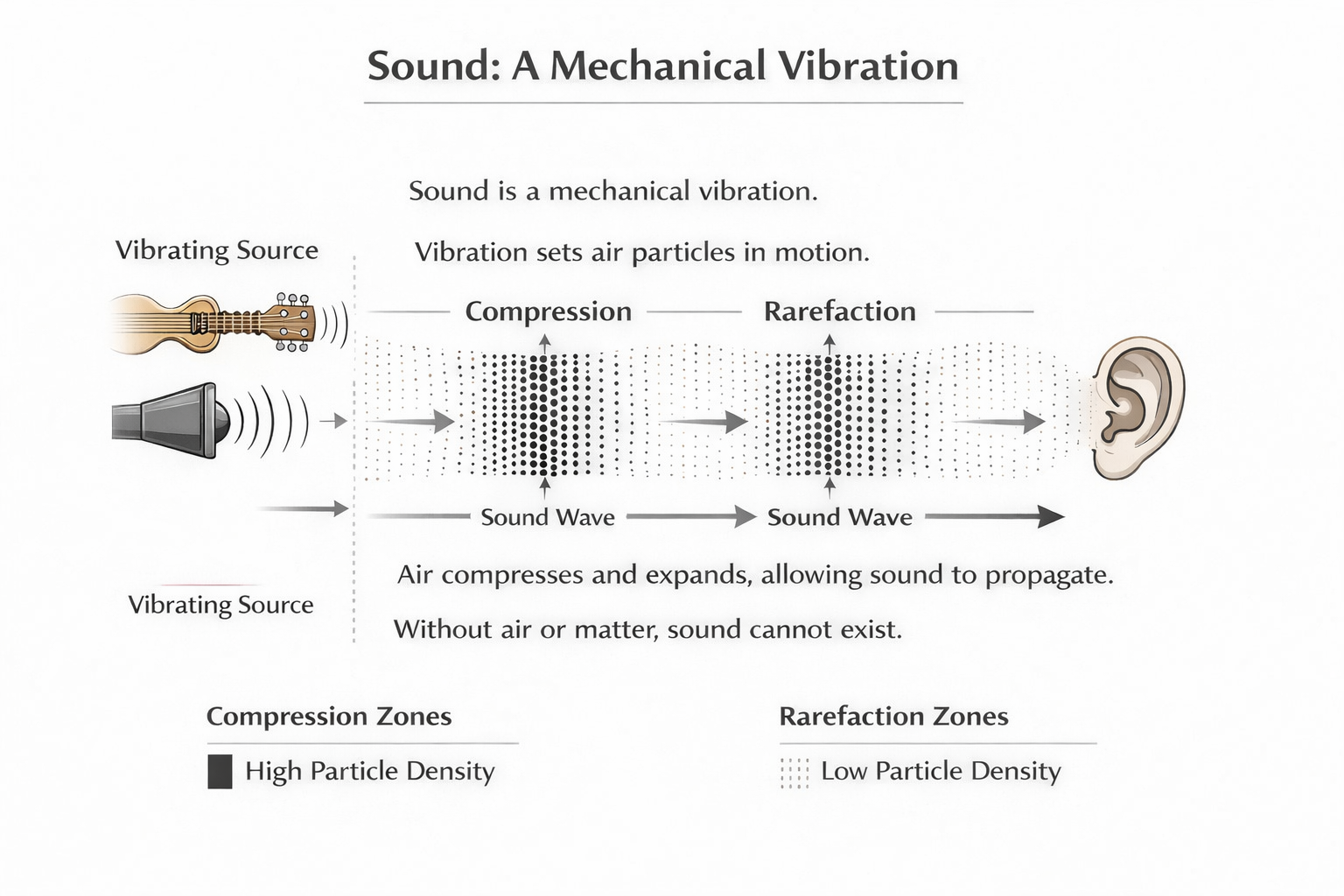
Sound Is a Mechanical Energy Transfer
Sound is not abstract.
It is mechanical energy traveling through a medium.
When an object vibrates — a guitar string, a loudspeaker cone, vocal cords — it displaces the surrounding air particles. These particles do not travel across the room. Instead, they oscillate around their resting position.
This oscillation creates alternating regions of:
- Compression (high pressure)
- Rarefaction (low pressure)
That pattern of pressure variation moves outward from the source as a longitudinal sound wave.
No air, no medium, no sound.
This is why sound cannot propagate in a vacuum.
Wavelength and Frequency: Why Bass and Treble Behave Differently
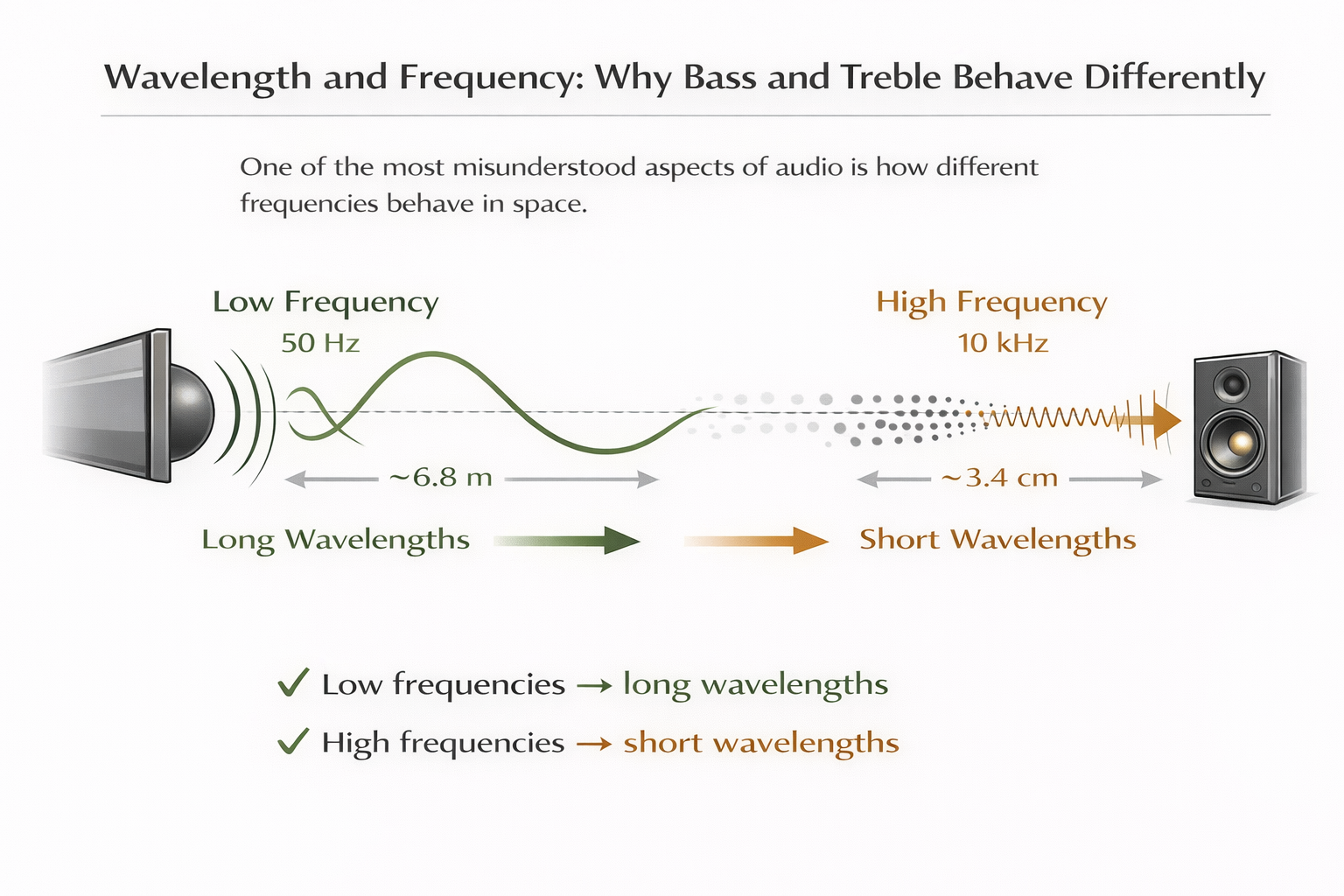
One of the most misunderstood aspects of audio is how different frequencies behave in space.
The key concept is wavelength.
- Low frequencies → long wavelengths
- High frequencies → short wavelengths
A 50 Hz wave can be several meters long.
A 10 kHz wave is only a few centimeters long.
This explains why:
- Bass travels through walls
- Low frequencies build up in corners
- High frequencies are easily absorbed
- Treble is more directional
Understanding wavelength is essential in:
- Room acoustics
- Studio design
- Speaker placement
- Phase alignment
The Audible Frequency Spectrum
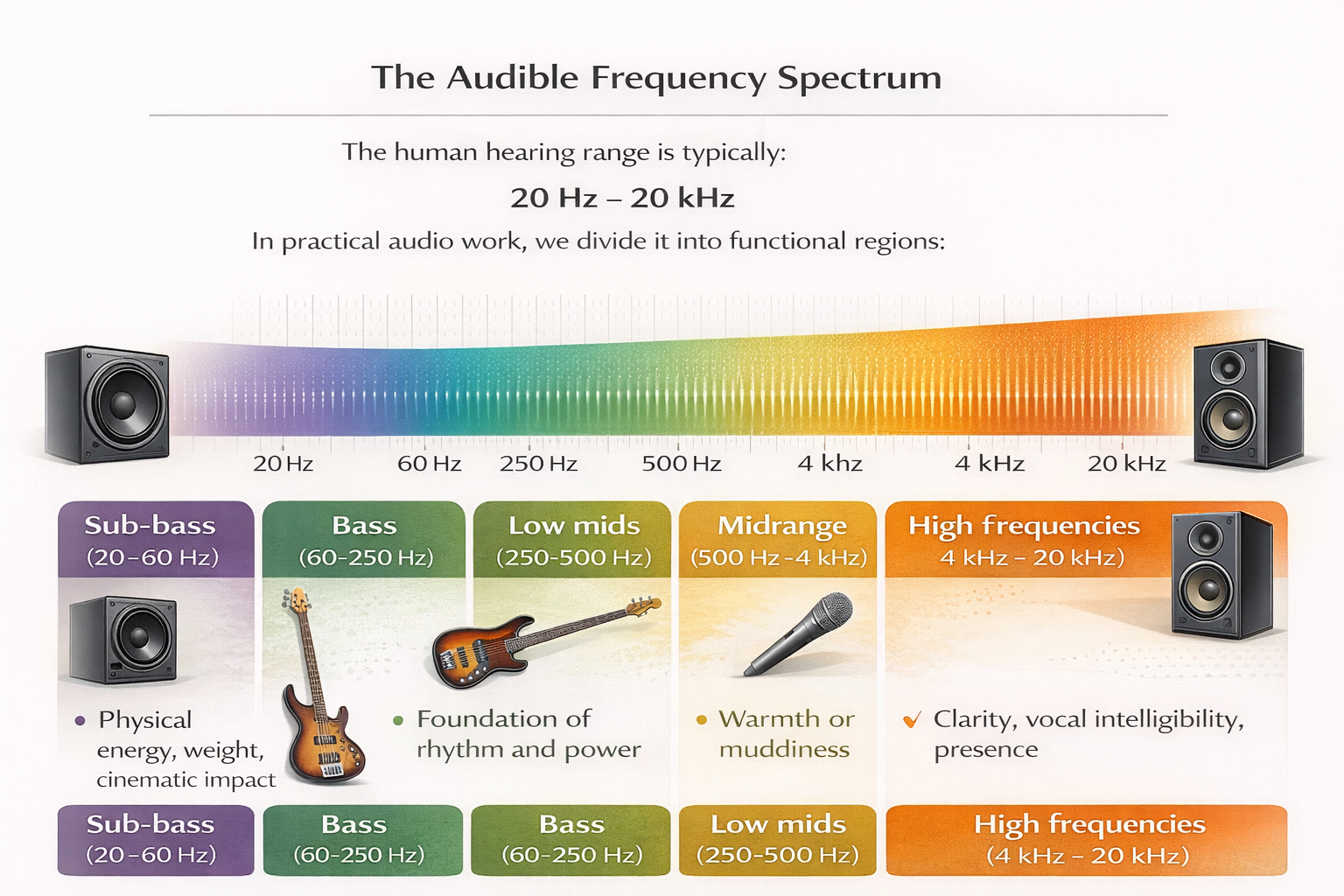
The human hearing range is typically:
20 Hz – 20 kHz
In practical audio work, we divide it into functional regions:
Sub-bass (20–60 Hz)
Physical energy, weight, cinematic impact.
Bass (60–250 Hz)
Foundation of rhythm and power.
Low mids (250–500 Hz)
Warmth or muddiness.
Midrange (500 Hz – 4 kHz)
Clarity, vocal intelligibility, presence.
High frequencies (4 kHz – 20 kHz)
Detail, brightness, air.
Most critical information lives in the midrange.
If your midrange balance is wrong, the entire mix collapses.
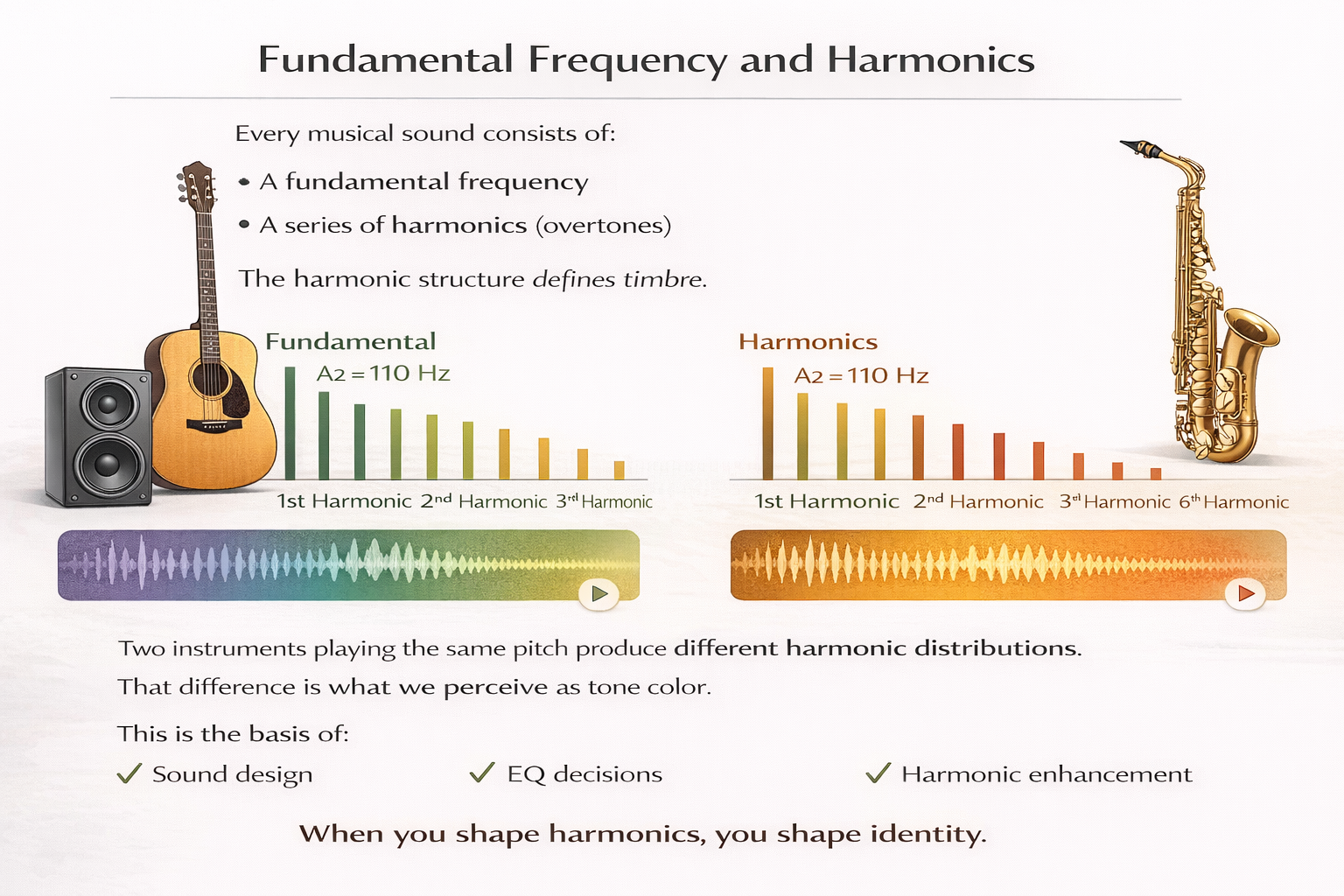
Fundamental Frequency and Harmonics
Every musical sound consists of:
- A fundamental frequency
- A series of harmonics (overtones)
The harmonic structure defines timbre.
Two instruments playing the same pitch produce different harmonic distributions. That difference is what we perceive as tone color.
This is the basis of:
- Sound design
- EQ decisions
- Saturation
- Harmonic enhancement
When you shape harmonics, you shape identity.
Acoustics: The Room Is Always Part of the Sound
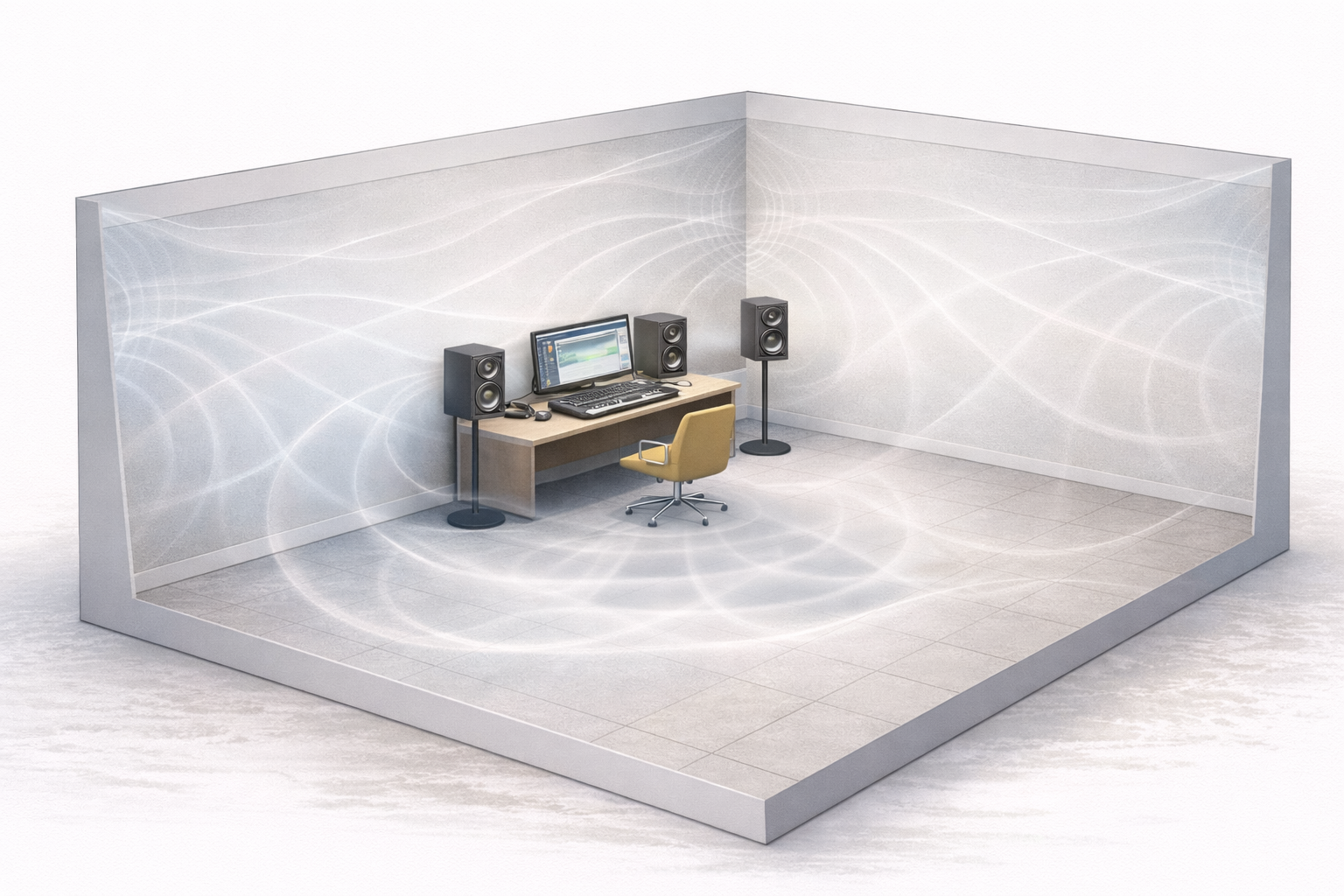
No monitoring system exists in isolation.
Sound interacts with:
- Walls
- Floors
- Ceilings
- Furniture
- Dimensions of the room
Low frequencies can create standing waves.
Certain frequencies may be reinforced while others are canceled due to phase interactions.
This is why untreated rooms create misleading mixes.
Acoustic awareness is not optional — it is foundational to accurate audio work.
Speed of Sound and Temperature
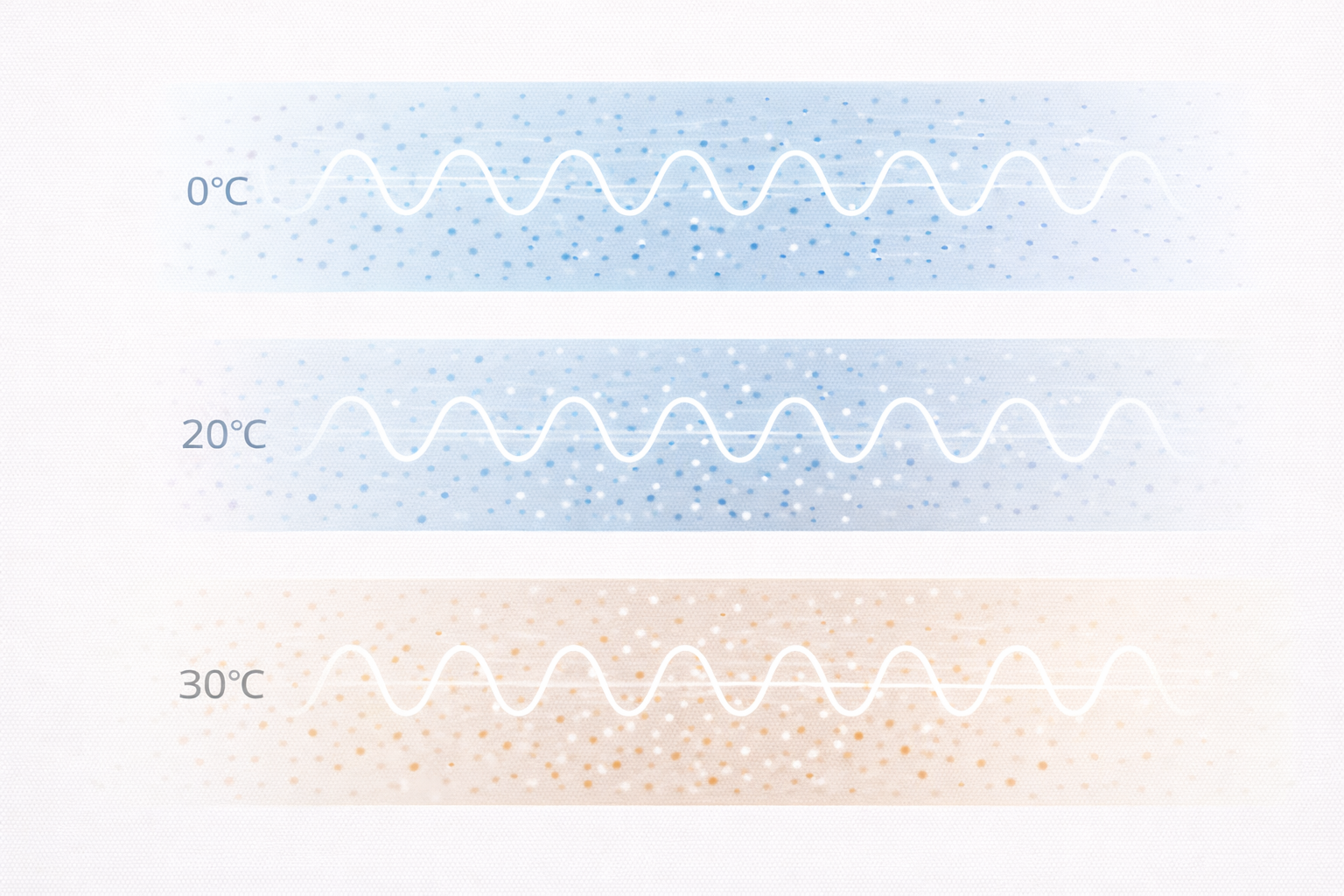
The speed of sound in air depends on temperature.
- At 0°C → ~331 m/s
- At 20°C → ~343 m/s
- At 30°C → ~349 m/s
As temperature increases, air molecules move faster, allowing sound waves to propagate more efficiently.
While the variation seems small, it becomes relevant in:
- Acoustic measurements
- Large venues
- Delay calculations
- Outdoor sound systems
From Acoustic Energy to Electrical Signal
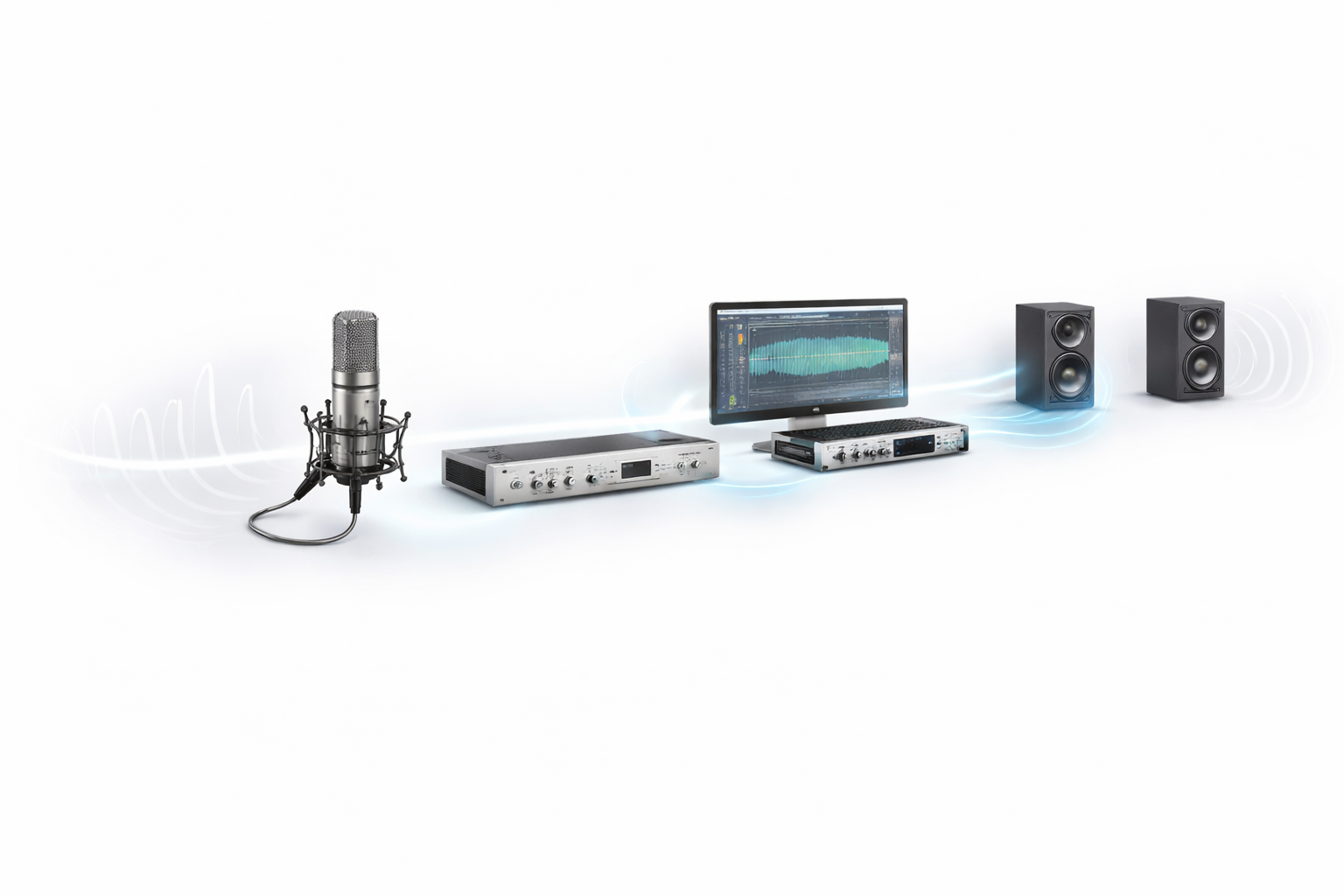
In professional audio, sound undergoes a transformation:
- Air vibration
- Microphone transduction
- Electrical amplification
- Analog-to-digital conversion
- Digital processing
- Digital-to-analog conversion
- Loudspeaker reproduction
Each stage influences fidelity, noise floor, dynamic range, and tonal accuracy.
A weak link anywhere in the signal chain compromises the final result.
Final Perspective
Understanding sound is not theoretical knowledge.
It directly affects:
- Mixing accuracy
- Monitoring decisions
- Acoustic treatment choices
- Phase management
- Creative sound design
Sound is physics.
But in the studio, physics becomes perception.
And perception defines quality.