
For a long time, many people believed that you needed years of classical music training to understand music theory. Today, things are very different. With modern home studios, DAWs, virtual instruments, and MIDI, thousands of producers create music every day without formally studying music theory.
And honestly… that’s completely fine.
But here’s something interesting:
Even if you produce “by ear”, you are already using music theory without realizing it.
Every time you create a melody in FL Studio, adjust MIDI notes, choose chords, or change the tempo of a track… you are already working with music theory concepts.
The goal of this article is not to turn you into a classical musician.
The goal is simply to help you understand the essential concepts that are actually useful for modern music production, in a practical and beginner-friendly way.
This guide is especially useful for:
- beatmakers,
- beginner producers,
- FL Studio and Ableton users,
- musicians producing by ear,
- and anyone who wants to better understand what they are doing inside their DAW.
Why Learn Basic Music Theory?
The truth is: you can absolutely create great music without reading advanced sheet music.
However, understanding a few basics can completely change the way you produce.
It helps you:
- work faster,
- create stronger melodies,
- understand plugins and instruments better,
- avoid musical mistakes,
- communicate with musicians,
- and improve your workflow overall.
Music theory becomes truly useful when it supports your creativity instead of limiting it.
The purpose is not to make music more complicated.
It’s actually the opposite.
It helps you transform musical ideas into reality more easily.
Musical Notes: The Language of Music
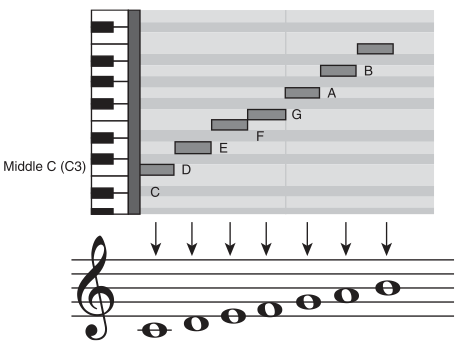
Western music mainly uses 7 notes:
- C
- D
- E
- F
- G
- A
- B
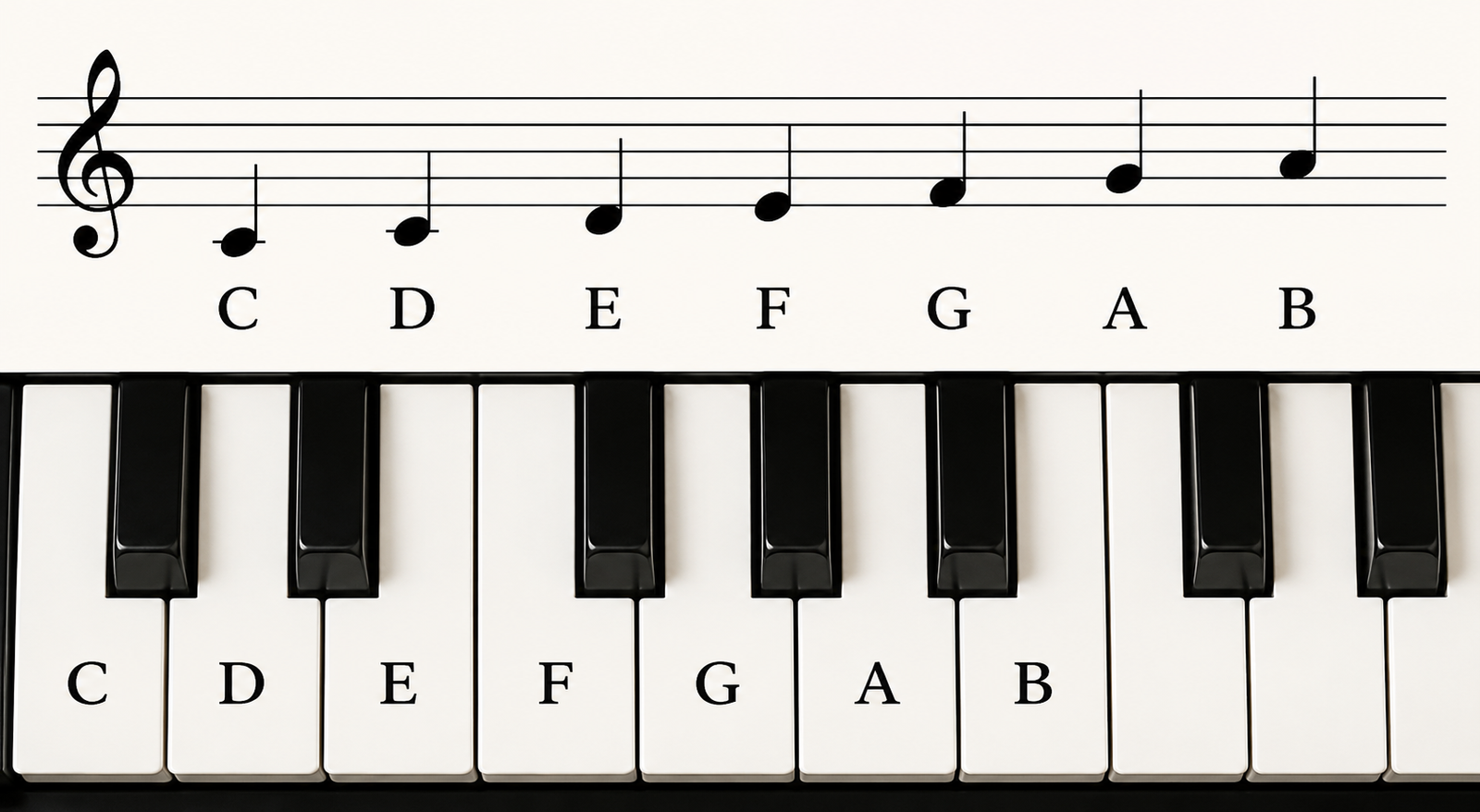
These notes repeat continuously across the keyboard.
If you are new to production, you probably already saw these letters inside your piano roll or MIDI editor.
At first, they may seem confusing, but after some practice, they quickly become natural.
Almost every modern DAW and virtual instrument uses this international notation system.
The Piano Keyboard: The Best Way to Visualize Music
Even if you are not a pianist, the piano keyboard is still one of the easiest ways to understand music visually.
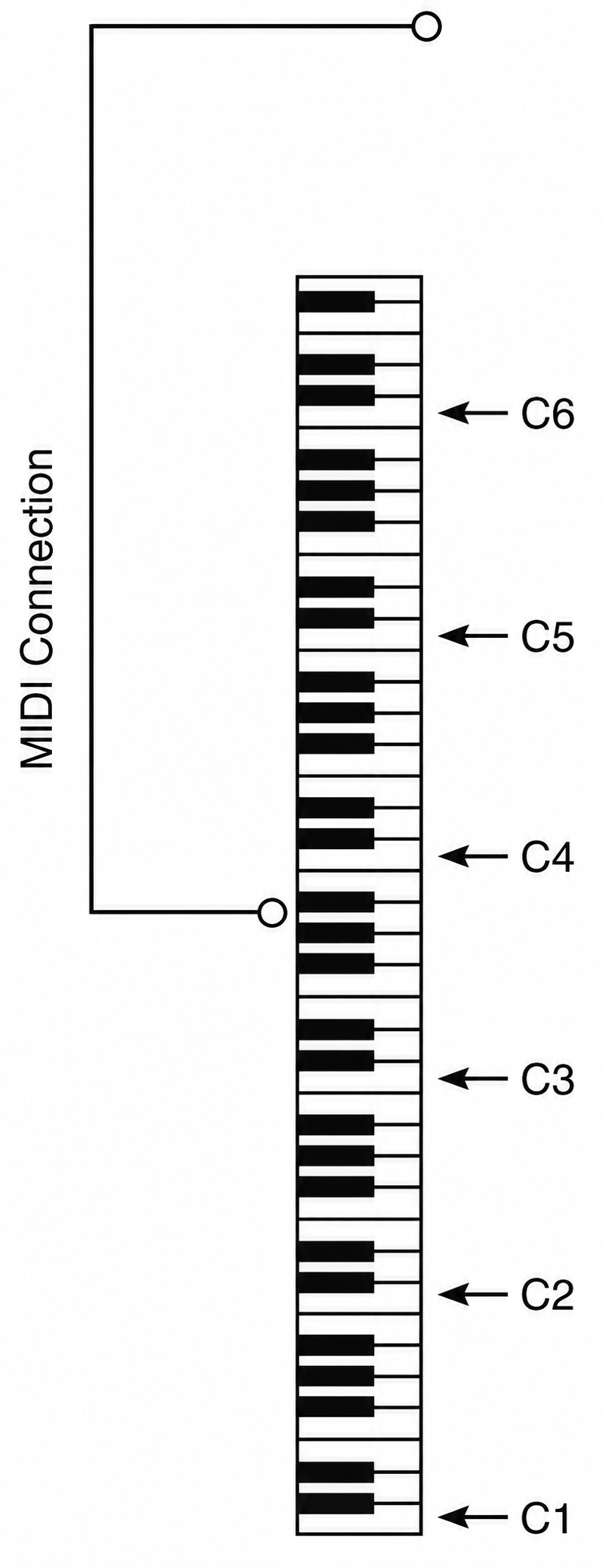
When you look at a keyboard, you immediately notice a repeating pattern:
- groups of 2 black keys,
- followed by groups of 3 black keys.
The C note is always located directly to the left of a group of 2 black keys.
Once you can identify C, finding all the other notes becomes much easier.
After some practice, you’ll start recognizing notes instinctively inside your DAW.
Octaves: Why Notes Repeat
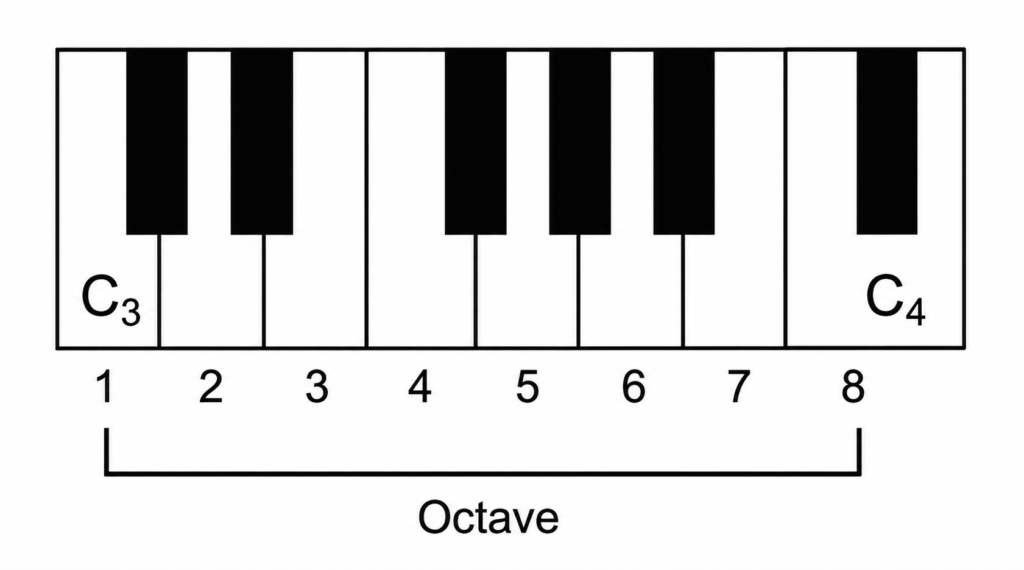
If you play a low C and then a higher C, they sound similar even though one is deeper and the other is brighter.
This distance between identical notes is called an octave.
For example:
- A3
- A4
- A5
are all A notes, but at different pitches.
There’s also a physical explanation behind this:
- 220 Hz
- 440 Hz
- 880 Hz
Each octave doubles the frequency.
That’s why our ears still recognize them as related notes.
Black Keys: Sharps and Flats
At first, black keys may look complicated, but the logic is actually simple.
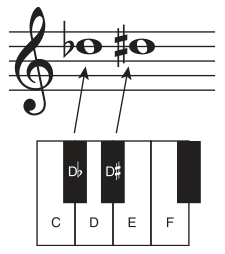
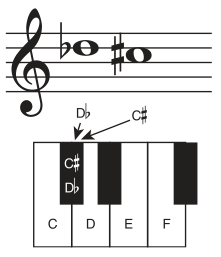
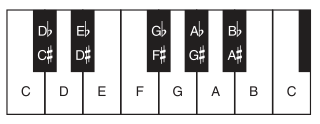
Black keys represent the notes located between white keys.
Examples:
- C# = C sharp
- Db = D flat
A sharp (#) raises a note slightly.
A flat (b) lowers a note slightly.
Interestingly, some notes have two different names:
- C# = Db
- D# = Eb
- F# = Gb
The sound is exactly the same — only the name changes depending on the musical context.
Rhythm: The Real Heart of Music
A melody can sound beautiful.
But without rhythm, music loses its energy.
Rhythm is one of the most important elements in modern genres such as:
- Hip-Hop
- Trap
- House
- Afro
- EDM
- Pop
- RnB
When your head naturally starts moving with a beat, rhythm is doing its job.
In modern production, understanding rhythm is almost as important as understanding notes.
Tempo and BPM
Tempo represents the speed of a song.
It is measured in BPM (Beats Per Minute).
Examples:
| Genre | Typical BPM |
|---|---|
| Hip-Hop | 70 – 95 BPM |
| Afro / Reggaeton | 90 – 105 BPM |
| House | 120 – 128 BPM |
| Trance | 130 – 145 BPM |
| Drum & Bass | 160 – 180 BPM |
The moment you open a project in FL Studio or Ableton, the BPM immediately changes the energy of the track.
Slow tempos often create emotional or heavy atmospheres.
Faster tempos usually create more tension and excitement.
Note Lengths
In music, not all notes last the same amount of time.
Some are short.
Some are long.
Inside a DAW, this becomes very visual thanks to the piano roll.
The main note values are:
| Name | Duration |
|---|---|
| Whole note | 4 beats |
| Half note | 2 beats |
| Quarter note | 1 beat |
| Eighth note | 1/2 beat |
| Sixteenth note | 1/4 beat |
Even if these names sound academic, you are probably already using them while drawing MIDI notes.
Groove: Why Human Music Is Never Perfect
Many beginner producers quantize everything perfectly to the grid.
Technically, it sounds clean.
But musically, it can quickly become robotic.
The best grooves often come from tiny imperfections:
- a slightly delayed kick,
- hi-hats placed a little off-grid,
- different note velocities,
- notes played with more or less energy.
These details create the human feeling in music.
Music feels alive because of those imperfections.
Silence Is Also Part of Music
Many beginners try to fill every empty space with sounds.
But silence is extremely important.
Musical space allows the track to:
- breathe,
- create dynamics,
- highlight important elements.
A great beat is not necessarily the one with the most sounds.
Sometimes it’s the one that leaves enough space for each sound to exist properly.
Quantization and Snap in DAWs
Modern DAWs can automatically align notes to the grid.
This is called:
- Snap
- Quantization
These tools are extremely useful, especially for correcting MIDI timing.
But with experience, many producers learn not to quantize everything perfectly.
Why?
Because music that is too perfect can lose its soul.
Do You Need to Read Sheet Music?
Not necessarily.
Today, many producers work entirely using:
- piano rolls,
- their ears,
- and their sense of groove.
Still, understanding the basics of musical notation can be very useful, especially when working with musicians or live instruments.
The treble clef is mainly used for melodies and higher sounds.
The bass clef is used for basslines and lower frequencies.
Even a basic understanding can help a lot.
Final Thoughts
Music theory is not here to block your creativity.
Actually, it can help unlock it.
Learning a few simple concepts can help you:
- understand your music better,
- compose faster,
- improve arrangements,
- and work more efficiently in your home studio.
At the end of the day, the most important things are still:
- listening,
- practicing,
- experimenting,
- and creating.
Music is not only about theory.
It is also about emotion, feeling, and creativity.